Environment
Our Commitment to Environmental Responsibility
Tenaska prioritizes the health and safety of our employees, the community and the environment. Our facilities are designed, built and operated with this in mind.
This is the responsible approach, but in addition, a power plant like Expedition Generating Station is heavily regulated. We must adhere to stringent state and federal regulations that are designed to preserve Central Virginia’s air and water quality and to protect human health and the environment.
Preserving air quality
Expedition cannot move forward without an Air Permit from the Virginia Department of Environmental Quality (DEQ). The agency will thoroughly review whether the plant can meet stringent air quality standards under the U.S. Clean Air Act. These standards are designed to protect the most vulnerable members of society, including the elderly, children and people with asthma.
Preliminary air modeling of both Expedition and the existing Tenaska power plant show the combined emissions of these facilities are well below the federal limits.
Once the plant is operational, Expedition will be required to submit quarterly air emissions monitoring reports, semi-annual monitoring and deviation reports, annual compliance certification and annual emissions inventory to DEQ. We must also submit quarterly CEMS (Continuous Emissions Monitoring Systems) data to the U.S. Environmental Protection Agency.
Non-compliance would result in penalties, fines and even possible shutdowns.
Watch this video to learn about the importance that our team places on air quality:
Federal air standards protect residents
The federal Clean Air Act and regulations from the U.S. EPA and Virginia DEQ establish standards to protect public health from air emissions. These are called the National Ambient Air Quality Standards (NAAQS) and are based on criteria to protect sensitive populations such as asthmatics, children and the elderly with an adequate margin of safety.
The issue that has attracted the most attention is the level of PM2.5 – which is small particulate matter that comes from a variety of sources including wood burning, car and truck exhaust, windblown dust, wildfires, pollen and power plants.
In 2024, the Biden Administration reduced the annual standard for PM2.5 by 25% after considering the latest health literature from experts, input from EPA’s independent Clean Air Scientific Advisory Committee and hundreds of thousands of public comments. The new standard was applauded by many public health and environmental groups. The EPA Administrator certified that the new standard would protect, with an adequate margin of safety, those with pre-existing cardiovascular and respiratory disease, children and elderly residents.
Given concerns about potential loosening of these federal standards, Expedition is committed to compliance with the NAAQS for fine particulate matter (PM2.5) that are in place today, unless more restrictive standards are required in the future. This commitment is a condition of the Special Use Permit approved by Fluvanna County in March 2026.
Fluvanna has clean air and this won’t change
If you want to know what sort of impact a new plant will have on Fluvanna County, take a close look at the county’s air and health statistics after more than 20 years of operating a natural gas-fueled power plant. The facts are clear – Tenaska’s consistent adherence to tight regulations has allowed the plant to generate reliable power for millions of homes, and bring in significant tax revenue to the county, while also keeping the county’s air safe.
- Fluvanna County’s PM2.5 concentrations are well below federal health-based standards based on data collected from the closest regional monitor.
- Fluvanna County’s rates of adult asthma, COPD and all types of cancer are in line with surrounding counties without natural gas-fueled power plants.
- Tenaska’s current plant in Fluvanna operates well below its permitted emission limits. These limits are set by DEQ to protect public health and the environment, based upon plant design and related ambient impacts, and the plant’s emissions stay far under those levels.
- Preliminary air quality modeling of both the existing plant and Expedition combined predicts maximum annual cumulative impacts from PM2.5 to be 7-15 times better than the federal and state standards.
Efficient water use
Expedition will be a combined-cycle power plant: electricity is generated using clean-burning natural gas, with the exhaust heat used to create additional electricity without the need for additional fuel. The process makes efficient use of fuel and water.
On average, Expedition will require 6-7 million gallons of water per day, sourced from the James River. This use is equivalent to less than 1% of the river’s average flow. Water withdrawals will be curtailed during times of drought.
Water will be reused 6-10 times during the power generation process, minimizing consumptive use and discharge. Roughly 80% of the water evaporates, leaving 20% that will be treated before it is discharged to the Rivanna River.
Tenaska’s existing Fluvanna County power plant has discharged into the Rivanna River for years. The Rivanna Conservation Alliance’s 2025 Rivanna River Watershed System Health Report shows the Rivanna is among the healthiest waterways in the region.
Average daily discharge is anticipated to be 1.5 million gallons, which is less than 1% of the average flow of the Rivanna River. Expedition will need to obtain a water discharge (Virginia Pollutant Discharge Elimination System, or VPDES) permit to discharge this wastewater. The permit will establish discharge limits and monitoring requirements.
At the request of Fluvanna County, Expedition will make its treated wastewater available for county use. This will further reduce the amount of water that is released.
Stringent permitting process
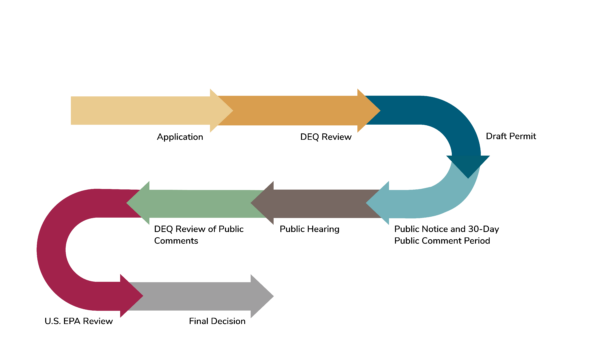
DEQ has technical experts, monitoring capabilities and expertise to evaluate and issue permits on complex and technical issues. DEQ solicits input and review from federal and state agencies, such as the U.S. Environmental Protection Agency, the Virginia Department of Health and the Virginia Department of Wildlife Resources, among other agencies.
Before a permit is issued, DEQ releases a draft permit, opens a public comment period and provides an opportunity for a public hearing. That means the public has multiple chances to review the draft permit, ask questions and share input before a final decision is made.