Frequently asked questions
We strive to be a good business neighbor and understand the importance of keeping the local community informed as this project develops. Our team is ready to answer your questions.
FAQ categories
GENERAL | Energy landscape | Community | Sound | Air | Water | Safety | Construction
General
How much power would Expedition generate?
The Expedition Generating Station would generate up to 1,540 megawatts, enough to reliably power 1.5 million homes.
It is important to note that a natural gas power plant requires about 50 acres for operations. However, Tenaska typically acquires additional land for easements, construction laydown and buffer between adjacent properties. Tenaska is siting the Expedition facility on 50 acres within our 425-acre site.
In comparison, a solar project able to generate a comparable amount of power requires 30,000 to 40,000 acres.
A natural gas power plant provides more electricity – and more reliably – on a smaller footprint, in part because of its ability to generate power all hours of the day.
Why did you select Fluvanna County for another power plant?
Tenaska has been a good business neighbor in Fluvanna County for more than 20 years. We have built positive relationships and feel like a welcomed and valued member of the community. The growing market demand for reliable power in this region and the existing infrastructure in Fluvanna County have created an opportunity for Tenaska to bring additional investment to this community. We look forward to working with the community to bring this project and its economic benefits to fruition.
How will this affect existing transmission lines in Fluvanna?
The Expedition Generating Station plans to use existing transmission infrastructure and connect into the existing Cunningham substation. Expedition is NOT connecting to the proposed Valley Link transmission line and is NOT associated with that project.
Is the Expedition project utilizing Valley Link’s Joshua Falls to Yeat transmission project?
Expedition will be connecting into the existing Cunningham substation and is not reliant on Valley Link’s Joshua Falls to Yeat transmission project.
Is there a customer for the power (power purchase agreement / offtaker)?
Tenaska has not finalized an offtake contract for this project, as these types of agreements typically come later in development. There is a significant need in the market for natural gas projects like Expedition that can provide reliable energy and help meet increased electric demand in Fluvanna County and Virginia.
What study has been done to predict how this will affect real estate values?
There are a number of factors that influence property values and the housing market. It has been our experience with other Tenaska projects of similar size and design that property values have not been negatively affected by plant operations. In fact, the jobs and increased tax revenue for the community typically have a positive impact on local schools and other amenities that factor into property values.
The presence of the Tenaska Virginia plant does not appear to have deterred housing growth. By our rough calculations, the number of homes within one mile of the plant has grown 35% between 2002 and 2024. Looking at the county as a whole, residential housing increased by 26% during the same time period.
What are the plans for decommissioning the plant at the end of its life cycle?
Under the conditions of the Special Use Permit approved by Fluvanna County, Expedition must submit a decommissioning plan and post a decommissioning bond.
What permits and approvals are needed to bring this project to fruition?
Expedition has received its required land use approvals from Fluvanna County. However, the project cannot move forward until it has received all required state and federal permits, which includes:
- Virginia Certificate of Public Convenience and Necessity (State Corporation Commission)
- Prevention of Significant Deterioration (PSD) Air Quality Permit (DEQ)
- Title V Operating Permit (DEQ)
- Virginia Pollutant Discharge Elimination System (VPDES) Wastewater Discharge Permit (DEQ)
- Virginia Water Protection Permit (DEQ) / Clean Water Act Section 404 Permit (USACE) for wetlands, T&E species, cultural and historical resources
- Construction stormwater permit(s) with post-construction stormwater requirements (DEQ, Fluvanna County)
Pending all the required permits, the earliest construction start would be in late 2027, with the earliest operations in late 2031.
Are there plans for the new plant to utilize back-up diesel fuel for emergency power operation? If so, how much fuel will be kept on site?
The plant is being designed to operate on both natural gas and ultra-low sulfur diesel fuel. The plant would only operate on diesel fuel when required to do so by the grid operator, typically in emergency operation conditions such as a winter storm and for required testing. We anticipate keeping a four-day supply of diesel fuel on site. Diesel fuel is more expensive than natural gas and is more challenging from an operational perspective, but it does provide additional reliability and ensures we can provide power when it is most needed.
Is the existing pipeline large enough for the new plant?
The existing pipelines are currently being evaluated to determine the amount of available capacity. Existing lines will be utilized to the extent possible and new lines will be built as needed, utilizing existing rights-of-way to the maximum extent practical.
There is at least a five-year backlog on the delivery of gas turbines. Has Tenaska already ordered the turbines?
Yes. Tenaska has entered into contracts to secure all the long-lead-time equipment, including the combustion turbine generators, that is necessary to complete the project on the targeted schedule.
What is the plan to address viewshed impacts?
Tenaska has acquired a large amount of wooded property near the existing power plant for this new facility. As envisioned, the Expedition Generating Station would be situated on approximately 50 acres of the 425-acre site, providing ample setback and visual and sound buffer. Keep in mind that there is minimal view of the existing plant, given the tree line and topography of the location.
Tenaska has also acquired approximately 350 acres of land slightly to the south, which we will put into perpetual conservation easement as part of our development plan. We believe this will help preserve the rural character of this part of Fluvanna County.
What is the plan for managing the trees/vegetation buffer?
Tenaska will manage the vegetative buffer with the goal of maintaining a healthy forest. We will work with the Virginia Department of Forestry to implement a forestry management plan, which will be overseen by an area forester.
What will be the impact on wildlife?
Impacts to wildlife are expected to be minimal. We will conduct various on-site environmental studies prior to the start of construction to understand and mitigate potential impacts on wildlife. The project will comply with all applicable state and federal permit requirements associated with wildlife, including the U.S. Fish and Wildlife Service. Additionally, the project’s air and water discharge permits will be protective of both human health and wildlife.
Is Tenaska willing to invest in native plants / pollinator plants in the conservation property as well as cultivated parts of the other plants?
Tenaska will manage the unused portions of our project site under a forestry management plan overseen by an area forester. Under this plan, the existing pines will occasionally be thinned to allow for native hardwoods to replace them slowly over time. Doing this slowly, over a period of many years, will allow a continuous vegetative buffer around the facility to be maintained at all times to help reduce sound and visual impacts.
Regarding the conservation parcels, Tenaska will work with the holder of the conservation easement, such as the Virginia Outdoors Foundation, to legally enforce the conservation requirements.
What plans are in place to mitigate potential negative social impacts, such as increased traffic, noise, or strain on local services?
The Expedition Generating Station would provide significant positive benefits to the community in terms of jobs, contractor opportunities and nearly $250 million in tax revenue that can support schools and other local services while helping to alleviate the residential tax burden. Tenaska has proven time and again to be a good business neighbor, supporting first responders, schools, students and other community needs.
Our team listens to community concerns and has worked hard to mitigate project impacts and maximize local benefits. This includes:
- Placing 350 acres into perpetual conservation easement.
- Inclusion of the latest sound mitigation technology and stricter sound standards.
- A Good Neighbor Fund that would provide annual payments – totaling approximately $5 million – to Fluvanna County homeowners within 2 miles of either the existing Tenaska Virginia plant or the Expedition project during each year of construction.
- A Community Advisory Board that would ensure continued dialogue between Tenaska and the community over the course of development, construction and into operation.
- Construction of a roundabout at the intersection of Ruritan Lake Road and Highway 53, which is already seeing high volumes of traffic.
- $7 million in funding for first responders that can be used for a future first responder station in the Kidds Store area and to support the sheriff’s department.
Tenaska’s application to the State Corporation Commission describes not only the generating station but also the supporting electrical infrastructure, including a new 500-kV switchyard, approximately 1.8 miles of generator-tie transmission line and modifications to the existing Cunningham Substation. Why were these not included in the application reviewed by Fluvanna County?
The filing with the county expressly stated that additional electric, gas, water and wastewater infrastructure would be required and explained that the project was being sited adjacent to the existing Tenaska facility to utilize existing utility easements, transmission infrastructure and substations.
In addition, the Special Use Permit application package included conceptual and illustrative site plans showing the project layout, including the project substation, as well as location mapping depicting the transmission corridor, routing and interconnection location. The application also included supporting exhibits addressing traffic, sound, environmental resources, landscaping, lighting, visual impacts and site access.
The application filed with the State Corporation Commission contains a greater level of engineering detail because those agencies review different aspects of the project. However, the existence of additional technical detail in state filings does not mean the infrastructure was new or previously undisclosed. The essential components of the project, including the generating station, electrical interconnection facilities, supporting utility infrastructure and overall project footprint, were clearly communicated in the application submitted to Fluvanna County.
Energy landscape
Who will benefit from the use of the electricity produced by the plant?
Virginia is a net importer of electricity, and the Commonwealth’s energy needs continue to grow. The Expedition Generating Station is located near the center of Virginia and integrated into the electrical infrastructure that serves Fluvanna County and the Commonwealth.
The regional grid operator – PJM Interconnection – showed a shortfall of 6,625 megawatts in its December 2025 capacity auction report. PJM’s Reliability Resource Initiative identified 51 energy projects in 13 states deemed critical to come online to maintain the reliability of the electric grid that serves Virginia. The Expedition project was selected as part of that process and is now an element in PJM’s plans for energy reliability.
What relationship does the timing of this second Tenaska power plant have to the proliferation of data centers and their gigantic need for power, massive amounts of water and their multiplication of transmission lines?
There are multiple factors driving the need for additional reliable natural gas power generation in Virginia, including growing energy demand, retiring coal generation and increased renewable energy. With respect to increased energy demand, data centers are a component of this growth as well as reshoring of manufacturing, population growth and increased economic growth, among other drivers.
Can you tell me why Tenaska wants to build a second plant in Fluvanna County, Virginia? Are you hoping to supply the growing data center sector here?
The Expedition Generating Station is under development in response to Virginia’s growing energy crisis. Demand for electricity is expected to double over the next decade, but the Commonwealth already can’t produce enough power to meet its own needs and relies heavily on electricity from other states. New generation – particularly from reliable and dispatchable sources such as natural gas – is critical.
Located in Central Virginia and directly connected to the grid that serves Fluvanna County and the rest of the Commonwealth, the plant would provide up to 1,540 megawatts of reliable power, enough to serve about 1.5 million homes.
The regional grid operator – PJM Interconnection – showed a shortfall of 6,625 megawatts in its December 2025 capacity auction report. PJM’s Reliability Resource Initiative identified 51 energy projects in 13 states deemed critical to come online to maintain the reliability of the electric grid that serves Virginia. The Expedition project was selected as part of that process and is now an element in PJM’s plans for energy reliability.
There are multiple factors driving the need for additional reliable natural gas power generation in Virginia, including growing energy demand, retiring coal generation and increased renewable energy. With respect to increased energy demand, data centers are a component of this growth as well as reshoring of manufacturing, population growth and increased economic growth, among other drivers.
Tenaska has a 20-year record of being a good business neighbor in Fluvanna County, and this location has access to transmission, natural gas and water supply – all of which are necessary for a natural gas power plant. We believe the Expedition Generating Station project will help expand the county’s tax base at a time when residential tax bills continue to rise and emergency responders, schools and other county services are short on funding.
What is your plan to mitigate the risks of the new plant becoming a stranded asset as the energy landscape shifts?
Natural gas power plants have been a major source of electricity generation in the U.S. for decades and are expected to continue to play a critical role for decades to come. Growing energy demand, an abundant supply of domestic natural gas, and the reliability and flexibility of natural gas technology provide robust long-term fundamentals for the Expedition project.
What mitigation, conversion and decommissioning strategies are in place should the proposed plant become a “stranded asset” as the energy landscape shifts toward renewable sources?
Natural gas power plants have been a major source of electricity generation in the U.S. for decades and are expected to continue to play a critical role for decades to come. Growing energy demand, an abundant supply of domestic natural gas, and the reliability and flexibility of natural gas technology provide robust long-term fundamentals for the Expedition project.
Virginia is a net importer of electricity, and the Commonwealth’s energy needs continue to grow. The Expedition Generating Station is located near the center of Virginia and integrated into the electrical infrastructure that serves Fluvanna County and the Commonwealth.
The regional grid operator – PJM Interconnection – showed a shortfall of 6,625 megawatts in its December 2025 capacity auction report. PJM’s Reliability Resource Initiative identified 51 energy projects in 13 states deemed critical to come online to maintain the reliability of the electric grid that serves Virginia. The Expedition project was selected as part of that process and is now an element in PJM’s plans for energy reliability.
Why would you build a natural gas-fueled power plant instead of a renewables facility?
Tenaska is an all-of-the-above company that develops a wide range of energy projects, including natural gas, wind, solar and battery storage. We consider the market need and best fit when determining what types of projects to develop and at which location. Right now, there is a market need for reliable power from dispatchable sources such as natural gas-fueled facilities to help meet growing demand. Natural gas remains an abundant and domestically available fuel source, promoting America’s energy independence.
In view of Tenaska’s expertise in electric grid connectivity, has there been any consideration in adding a diversified product such as solar?
Tenaska is an all-of-the-above company that develops natural gas power plants, solar projects, wind farms, battery energy storage and more. We consider the best fit to meet market and customer needs in determining where to site projects. Right now, customers and regional transmission grid PJM Interconnection are in need of reliable power generation, which is best met by natural gas. That is our focus for Fluvanna County.
Community
Will people in this county be employed at Expedition, and how many?
Tenaska takes pride in hiring local when possible. Today, there are 29 employees at Tenaska Virginia, of which 19 live in Fluvanna County and 10 are graduates of area high schools. We expect the Expedition facility to provide 29 direct jobs. Job opportunities at the new facility will be posted closer to the start of operations.
Will the people building Expedition be local or will they be brought in from other states?
Tenaska makes it a priority to ensure that local workers are utilized by our contractors to the maximum extent practical. Interested contractors and vendors can submit their information using our contractors and vendors form.
Are you fully committed to putting the two undeveloped parcels into a conservation easement?
Yes. Through an agreement with Fluvanna County, Expedition is required to place those two southern parcels into perpetual conversation easement.
Has Tenaska already purchased the property for Expedition and for the conservation easements?
Tenaska has acquired property via a purchase option agreement that provides the Expedition project with the exclusive right and option to purchase the property. This includes the main project property and the land that would be put into conservation easement. This agreement has been recorded with Fluvanna County.
Is this going to lower power bill taxes and cost?
Electric utility bills are determined by the utility, such as Central Virginia Electric Cooperative or Dominion Energy, and the State Corporation Commission. There are many factors that determine electric utility rates, including energy demand, which is growing rapidly. In general, low-cost generation like natural gas will increase the supply of reliable electricity in Virginia and, therefore, is anticipated to be a positive factor in helping to stabilize energy pricing.
Have you performed an Environmental Justice assessment?
Yes. There are environmental justice components as part of the state permitting processes.
Additionally, our team has had many conversations with Fluvanna County residents – both in group settings and individually. These conversations will continue over the lengthy development period and beyond. We have and continue to incorporate community feedback into our plans.
To date (since June 2025), our community outreach has included a project website with details about the proposed Expedition Generating Station, including a map, rendering and comprehensive list of Frequently Asked Questions (FAQs); videos of key topics of interest to the community; a dedicated project email address and phone number; advertisements in the local newspaper of record; interviews with local media outlets; email blasts; direct mail; small group briefings; neighbors surveys and home visits; county-wide mailings; and a community open house.
Expedition has started the process of establishing a Community Advisory Board (CAB) to ensure two-way dialogue with neighbors and the broader community continues over the remainder of development, through construction and into operation.
How will you incorporate the community’s concerns into project decision-making?
Public education and community outreach are critical for projects like Expedition. This fosters trust and a productive dialogue around community concerns.
Our team has had many conversations with Fluvanna County residents – both in group settings and individually. These conversations will continue over the lengthy development period and beyond.
To date (since June 2025), our community outreach has included a project website with details about the proposed Expedition Generating Station, including a map, rendering and comprehensive list of Frequently Asked Questions (FAQs); videos of key topics of interest to the community; a dedicated project email address and phone number; advertisements in the local newspaper of record; interviews with local media outlets; email blasts; direct mail; small group briefings; neighbors surveys and home visits; county-wide mailings; and a community open house.
We have been working hard to respond to community concerns, mitigate project impacts and maximize local benefits. This includes:
- Placing 350 acres into perpetual conservation easement.
- Inclusion of the latest sound mitigation technology and stricter sound standards.
- A Good Neighbor Fund that would provide annual payments – totaling approximately $5 million – to Fluvanna County homeowners within 2 miles of either the existing Tenaska Virginia plant or the Expedition project during each year of construction.
- A Community Advisory Board that would ensure continued dialogue between Tenaska and the community over the course of development, construction and into operation.
- Construction of a roundabout at the intersection of Ruritan Lake Road and Highway 53, which is already seeing high volumes of traffic.
- $7 million in funding for first responders that can be used for a future first responder station in the Kidds Store area and to support the sheriff’s department.
Tell me more about the Community Advisory Board.
As part of our community engagement work, Tenaska worked with consultant ERM to establish a Community Advisory Board (CAB). The purpose of the CAB is to ensure productive two-way dialogue about the Expedition project, with opportunities for CAB members to offer feedback and input.
The first meeting of the CAB was in July 2026. CAB meetings will be held quarterly through development, construction and the first year of operation of Expedition. Agendas and materials from CAB meetings can be found on the Community page.
Sound
What are the projected sound levels in decibels to the area surrounding the new plant?
As part of our work on the Expedition project, we have modeled the sound from both the existing Tenaska plant and the proposed facility. This model is based on what we consider a worst-case scenario. There are many factors that go into how sound travels and dissipates. It is influenced by wind direction, the number of leaves on the trees, humidity in the air, ambient sound and a host of other things. This model looks at how sound is expected to behave when all those factors are working against us.
We believe this model demonstrates Expedition can comply with the operational sound limits in the Special Use Permit approved by Fluvanna County: a one-hour LEQ of 60 decibels at the project boundary and of 50 decibels within 100 feet of a dwelling.
We also commissioned a second sound study from another firm given the importance of this topic. This firm worked independently and produced a study with similar results.
Please tell us what sound studies for the existing plant have shown.
Personnel at the existing plant have taken numerous sound measurements over the years, and third-party sound studies have been conducted. Of note: in 2008, at the request of a county-appointed Sound Committee, a third-party sound expert was engaged to study the sound levels from the facility. Measurements were taken during daytime and nighttime hours during start-up and normal operations. This expert, who was selected by the Sound Committee and received his findings, found there were seasonal fluctuations – still within permitted levels – primarily caused by foliage conditions and insects. This expert, as well as subsequent measurements and studies, found the existing plant to be in compliance with the requirement of 60 decibels (dBA) or less at the property line and 50 dBA or less at any existing adjacent dwelling. From an operational perspective, nothing at the facility that would impact sound levels has changed.
Does the orientation of the plant impact the sound?
Off-site sound levels are driven by a number of factors, including atmospheric conditions, topography and vegetation. The location and orientation of plant equipment also play a role in off-site sound impacts. We take these factors into account in our sound modeling, which we consider when orienting the facility and designing equipment. Our goal is to minimize the sound impacts to everyone in the area.
What is the plan to address sound?
When it comes to the proposed Expedition project, we believe that our plans include ample buffer land to help with sound mitigation, as we only intend to use 12% of the 425-acre site. Other mitigation measures required by the Special Use Permit approved by Fluvanna County will include:
- Combustion turbine generators shall be housed in buildings or enclosures to limit sound levels
- Exhaust stacks shall be equipped with silencers
- Low-noise fans shall be used on plant heat exchangers
- Emissions control technology will be used
- Gas turbine air inlets shall be equipped with silencers
If Expedition incorporates dry cooling, will the plant still be able to meet the sound requirements in the Special Use Permit?
Yes. The sound modeling for Expedition contemplated a “maximum case” scenario, which included dry cooling and a variety of other factors.
Air
How will this plant impact air quality in the region?
The new plant will become operational only if it receives an Air Permit from the Virginia Department of Environmental Quality (DEQ) stating it will meet stringent air quality standards under the U.S. Clean Air Act and DEQ regulations.
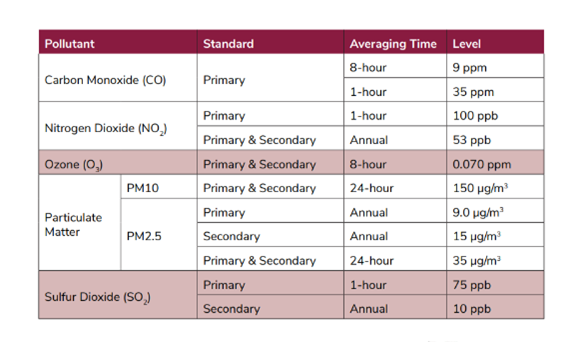
The Clean Air Act establishes the process for protecting public health from air emissions. This is done through National Ambient Air Quality Standards that are based on criteria allowing for an adequate margin of safety and are requisite to protect the public health.
The primary NAAQS standards provide public health protection, including the health of ‘sensitive’ populations such as asthmatics, children and the elderly. In 2024, the EPA under the Biden administration significantly strengthened the annual standard for PM2.5. The new standard was widely praised by public health organizations.
For its existing facility, Tenaska submits quarterly air emissions monitoring reports, semi-annual monitoring and deviation reports, annual compliance certification and annual emissions inventory to DEQ. We also submit quarterly CEMS (Continuous Emissions Monitoring Systems) data to the U.S. EPA. The Expedition plant would follow the same compliance protocols.
Is there current data about air impact and how the new facility will impact that?
Air quality impacts will be assessed via the air permit application, which will include extensive modeling to predict ground-level concentrations of numerous pollutants from not only Expedition but from other surrounding sources (including the existing plant) as well as monitored background concentrations. The cumulative concentrations will then be compared to ambient standards, which are set by the U.S. Environmental Protection Agency to be protective of human health and the environment. The DEQ will spend months reviewing the application and will issue a permit only if all requirements are met.
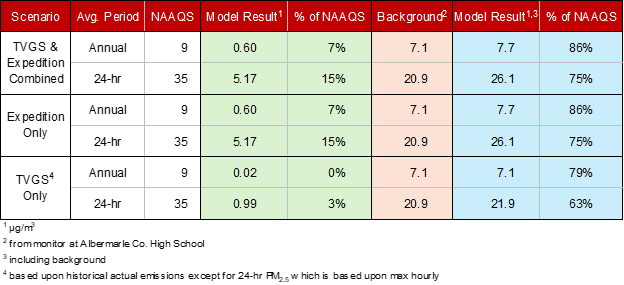
We have provided three supplementary environmental memos to the county, one of which includes preliminary air quality modeling for maximum cumulative impacts from both the existing plant and Expedition combined predicts emissions to be 7-15 times less than the federal and state standards for PM2.5.
What independent organization is monitoring air emissions?
The Virginia Department of Environmental Quality (DEQ) is the agency that would issue a Prevention of Significant Deterioration Air Quality Permit, required prior to construction, and a Title V Operating Permit after commencement of operation. This agency has stringent requirements related to air quality and natural gas power plants that are intended to protect human health and the environment.
Expedition will be required to demonstrate:
- That it is employing Best Available Control Technology (BACT) to minimize emissions.
- That emissions from the plant will not cause off-property concentrations to exceed each of the National Ambient Air Quality Standards (NAAQS) when including other specific surrounding sources and existing background concentrations.
For its existing facility, Tenaska submits quarterly air emissions monitoring reports, semi-annual monitoring and deviation reports, annual compliance certification and annual emissions inventory to the Virginia Department of Environmental Quality. We also submit quarterly CEMS (Continuous Emissions Monitoring Systems) data to the U.S. EPA. The Expedition plant would follow the same compliance protocols.
What opportunities will there be for public commentary as part of the air permitting process?
There will likely be at least three public participation opportunities. Tenaska will be required to hold an informational briefing after application submittal (scheduled for July 28, 2026 – click for info). Virginia Department of Environmental Quality (DEQ) will hold a public briefing once the draft permit is available and then will hold at least one public hearing during the comment period.
Isn’t President Trump rolling back the National Ambient Air Quality Standards (NAAQS) lowered by Biden in 2024?
Tenaska can’t speak to what President Trump intends to do.
What we can tell you is that Tenaska has an exemplary record of compliance. Our power plants operate at emissions levels far below the federal limits, and we do not intend to alter plant operations should NAAQS be revised.
Given concerns about potential loosening of federal standards, Expedition is committed to compliance with the NAAQS for fine particulate matter (PM2.5) that are in place today, unless more restrictive standards are required. This commitment is a condition of the Special Use Permit approved by Fluvanna County.
Have you monitored the amount of air pollution produced by your existing plant?
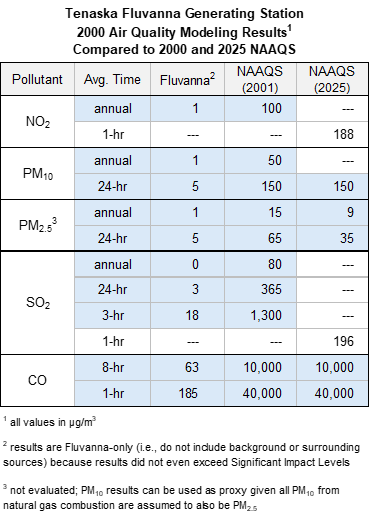
Modeling results from the Tenaska Virginia Generating Station’s air permitting process are shown here compared to the standards existing at the time that project was permitted and the current standards.
Tenaska Virginia’s contribution to air quality is shown in the middle column compared to the 2000 standards (4th column) and the current standards (last column).
As shown, the results are all less than 15% of the applicable standard. These results do not include background or surrounding sources as the plant’s results were so low (i.e., below the Significant Impact Levels) that modeling of surrounding sources was not required. PM2.5 was not evaluated in 2000, given the PM10 Surrogate Policy in effect at the time, but the PM10 results can be compared to the PM2.5 standards as all particulate matter emitted from natural gas combustion are considered to be both PM10 and PM2.5.
Our existing facility has an exemplary compliance record. Tenaska submits quarterly air emissions monitoring reports, semi-annual monitoring and deviation reports, annual compliance certification and annual emissions inventory to the Virginia Department of Environmental Quality (DEQ). We also submit quarterly CEMS (Continuous Emissions Monitoring Systems) data to the U.S. EPA. The Expedition plant would follow the same compliance protocols.
What are the regulated air emissions, and in what quantities?
Byproducts of natural gas combustion include nitrogen oxides, carbon monoxide, carbon dioxide, sulfur oxides, volatile organic compounds and particulate matter. The amounts of these by-products will be included in the air permit application.
What is the plan to address air emissions?
Air quality impacts will be assessed via the air permit application, which will include extensive modeling to predict ground-level concentrations of numerous pollutants from not only Expedition but from other surrounding sources (including the existing plant) as well as monitored background concentrations. The cumulative concentrations will then be compared to ambient standards, which are set by the U.S. Environmental Protection Agency to be protective of human health and the environment. Virginia Department of Environmental Quality (VDEQ) will spend months reviewing the application and will issue a permit only if all requirements are met.
Expedition will be required to demonstrate:
- That it is employing Best Available Control Technology (BACT) to minimize emissions.
- That emissions from the plant will not cause off-property concentrations to exceed each of the National Ambient Air Quality Standards (NAAQS) when including other specific surrounding sources and existing background concentrations.
Have any environmental studies been performed to evaluate the impact on wildlife?
Preliminary studies have been completed, and impacts to wildlife are expected to be minimal and would be mitigated as required (which could include performing certain construction activities during specified times of year to avoid impacts). The project will comply with all applicable state and federal permit requirements associated with wildlife, including the U.S. Fish and Wildlife Service.
Will the Virginia Department of Environmental Quality consider other sources of air emissions in the area, including the existing Tenaska plant, when reviewing Expedition’s air permit application?
The agency has told Tenaska that it will consider Expedition and the existing plant as a single source. Air quality modeling performed for Expedition’s air permit application was always going to include emissions from the existing plant.
What impact does the switch to dry cooling have on air emissions?
It will decrease emissions of particulate matter from the cooling towers.
Water
What are water source requirements in gallons per day for the existing facility and for the new proposed facility?
Expedition is being designed with dry cooling, which reduces the plant’s water needs by 85%.
Average Water Usage:
- Expedition: 1 million gallons per day
- Tenaska Virginia: 4 million gallons per day
Where will the water supply come from?
Water for power generation will be sourced from the James River. Expedition’s average water needs are 1 million gallons per day, approximately 0.03% of the average James River flow. Water withdrawals will be curtailed during times of drought.
The plant may need to use groundwater for its office operations (i.e. drinking water, sanitary uses).
How much more water would you need from the James River to cool the new facility?
Expedition is being designed with dry cooling, which reduces the plant’s water needs by 85%.
Average Water Usage:
- Expedition: 1 million gallons per day
- Tenaska Virginia: 4 million gallons per day
Water for power generation will be sourced from the James River. Expedition’s average water needs are 1 million gallons per day, approximately 0.03% of the average James River flow. Water withdrawals will be curtailed during times of drought.
Even with dry cooling, the amount of water used per day seems like a lot. Can you put this into perspective?
The switch to dry cooling reduces water needs by 85%. Average water use is anticipated to be approximately 1 million gallons per day (approximately 0.03% of the James River average daily flow), of which 800,000 gallons per day is returned to the watershed. The net “usage,” or the amount lost to evaporation, equates to approximately 3.2 cups of water to provide the average amount of electricity used by a Fluvanna County household per day.
When the original plant was built, there was technology to use water and recycle it. Why is this not being pursued at the new plant?
Similar to the existing plant, Expedition will be a combined-cycle facility: electricity is generated using clean-burning natural gas, with the exhaust heat used to create additional electricity without the need for additional fuel. The process makes efficient use of fuel and water.
We typically reuse water several times. After a certain number of cycles, the residual salts and minerals in the water are too heavy to continue using without damaging the equipment, and at this point we treat and discharge the water.
In addition, Expedition is being designed with dry cooling, which reduces water needs by 85%.
How is this new plant going to affect our water supply during drought times?
Water for power generation will be sourced from the James River. Expedition’s average water needs are 1 million gallons per day, approximately 0.03% of the average James River flow. Water withdrawals will be curtailed during times of drought.
How much is the water withdrawal, and have you modeled downstream river levels post the withdrawal?
Water for power generation will be sourced from the James River. Expedition’s average water needs are 1 million gallons per day, approximately 0.03% of the average James River flow. Water withdrawals will be curtailed during times of drought.
Is there a water intake approval required from the Virginia Department of Environmental Quality?
Water withdrawal intakes, including type and location, are regulated by the Virginia Department of Environmental Quality.
Will this site be zero-discharge on water used?
The project will not be a zero-discharge facility. However, water will be recycled as much as practicable to minimize water consumption.
What will the facility do with its wastewater?
The plant will need to obtain a water discharge (Virginia Pollutant Discharge Elimination System, or VPDES) permit to discharge wastewater. The permit will establish effluent limits and monitoring requirements. Tenaska will be responsible for ensuring compliance with the permit.
Average daily discharge is anticipated to be 0.8 million gallons per day into the Rivanna River. This is approximately 0.5% of the average flow of the river.
At the request of Fluvanna County, Expedition will make its treated wastewater available for county use. This will further reduce the amount of water that is released.
Will the water that will be discharged back into the Rivanna River be tested for all contaminants?
The Virginia Pollutant Discharge Elimination Permit will require monitoring to confirm compliance with applicable Federal Effluent Limit Guidelines as well as any contaminants that the Virginia Department of Environmental Quality determines, through their modeling procedures, require monitoring to ensure compliance with Water Quality Standards.
Our existing facility complies with standards for air and water that are intentionally designed to protect human health and the environment.
The Rivanna Conservation Alliance’s 2025 Rivanna River Watershed Stream Health Report shows the Rivanna River, where the current plant discharges, is among the healthiest waterways in the watershed.
What is the plan to address groundwater pollution?
The facility will have numerous protections to ensure that the groundwater is not contaminated. All chemicals are kept inside concrete containment basins, so that in the unlikely event of a spill, the chemicals will be contained. We will operate utilizing a Spill Prevention, Control and Countermeasure Plan, which is regulated by the U.S. Environmental Protection Agency. We will also have a stormwater pollution prevention plan and chemical handling plans.
Safety
What will be done to ensure human health and safety?
Safety is of utmost importance to Tenaska, and we work hard to design a safe plant that is protective of the employees, residents and wildlife. This has been demonstrated through the safe operation of the Tenaska Virginia facility, as well as the safe operations of the entire Tenaska fleet, which encompasses 6,600 megawatts of generation.
Employees at Tenaska Virginia have received dozens of awards from the National Safety Council, and the plant has been certified (and re-certified) as a Voluntary Protection Program (VPP) Star Worksite by the U.S. Occupational Safety and Health Administration – a recognition obtained by only 0.03% of work sites (3 in every 10,000), demonstrating our strong safety culture.
The Virginia Department of Environmental Quality has requirements related to air quality and natural gas power plants, including compliance with ambient air quality standards. Our facility will be designed, built and operated in compliance with these standards, which are intended to be protective of human health and the environment.
Has there ever been an emergency response at the existing plant?
Safety is a priority. Employees at the plant are trained to respond to emergency situations that could arise. Additionally, the plant routinely holds on-site training drills with local first responders, which ensures appropriate response plans are developed and practiced. In addition, these training drills offer opportunities for local first responders to practice their skills for the benefit of the community. While there have been many training drills at the plant, no major emergency response has been required.
What security measures will protect the plant from sabotage, terrorism or unauthorized access?
We will be required to meet security standards, most notably those from the North American Electric Reliability Corporation – Critical Infrastructure Protection, which we call NERC CIP. This is a set of security standards designed to protect the electric grid, including plants like ours, from cyber and physical threats. One of the key cybersecurity aspects of a plant like ours is that it is isolated from the Internet, so a hacker simply cannot reach our systems. We also have physical deterrents such as fencing and 24/7 monitoring.
What hazardous materials are stored on-site? What are they used for?
The facility will primarily use chemicals for emissions control, cooling systems, lubrication and water treatment. Ammonia is injected into the Heat Recovery Steam Generator to reduce air emissions. Water treatment chemicals include chlorine and dechlorinator, as well as chemicals to control the pH of the water and prevent scaling. Hydrogen is used for generator cooling, and glycol is used in some of the smaller plant heat exchangers. Lubricating oils are used in rotating equipment, and fuel oil is stored on site for emergency operation.
The plant would be required to submit a chemical inventory annually to the state emergency response commission, the local emergency planning committee and the local fire department that would respond to any chemical emergency.
Safety is always our top priority, and Tenaska’s existing facility has been recognized by U.S. Occupational Safety and Health Administration as a Voluntary Protection Program (VPP) Star site, a recognition obtained by only 0.03% of work sites (3 in every 10,000), demonstrating our strong safety culture.
Construction
How do you intend to restore the construction staging area?
The project will re-plant trees once construction of the facility is completed. The primary intent of this is to preserve the rural character of the area and to provide vegetative buffer. Tenaska will develop, with the assistance of an area forester, a forestry management plan that will ensure that a healthy forest is maintained. Maintaining a vegetative buffer around the facility with a healthy forest, slowly transitioning over time to a native hardwood forest, is our primary forest management goal.
What will be done to limit disruption to the community during construction traffic?
Construction will cause some temporary traffic disruption, but we want to minimize the impact on county residents and motorists.
While the construction phase is anticipated to span 48 months, the majority of the traffic volume will be focused in the 18 months of peak construction. The majority of this peak traffic – which will range from 300 to up to 800 personal vehicles – will be the workers who arrive early in the morning and leave in the afternoon.
Expedition is committed to staggering shift start times, encouraging carpooling and avoiding certain intersections at peak hours in order to minimize traffic disruptions during the months of peak construction.
In addition, Expedition is committing $6.5 million toward road improvements that lessen traffic congestion, with a particular focus on mitigation of the intersection of Ruritan Lake Road and Highway 53, which is already seeing high traffic volumes.
The project will develop a detailed traffic plan in collaboration with the county and the Virginia Department of Transportation that is based on actual road conditions, routing and schedules at the time of construction, rather than forward-looking projections.
How many cars and trucks will be on our local roads during construction?
While the construction phase is anticipated to span 48 months, the majority of the traffic volume will be focused in the 18 months of peak construction. The majority of this peak traffic – which will range from 300 to up to 800 personal vehicles – will be the workers who arrive early in the morning and leave in the afternoon.
Over the course of construction, there will be approximately 15 large pieces of equipment that require specialized delivery vehicles. These deliveries may involve escort vehicles and will require close coordination with the county and the Virginia Department of Transportation to minimize delays to local traffic.
How will you manage construction traffic?
Construction will cause some temporary traffic disruption, but we want to minimize the impact on county residents and motorists.
Expedition is committed to staggering shift start times, encouraging carpooling and avoiding certain intersections at peak hours in order to minimize traffic disruptions during the months of peak construction.
In addition, Expedition is committing $6.5 million toward road improvements that lessen traffic congestion, with a particular focus on mitigation of the intersection of Ruritan Lake Road and Highway 53, which is already seeing high traffic volumes.
Prior to construction, the project will develop a detailed traffic management plan that takes into account Tenaska’s strong commitment to safety and local concerns around busy intersections, timing of construction traffic around school and other peak times, road conditions and other factors. We will also explore, with our contractors, the potential for shuttling, staggered shifts and incentives for carpooling.
Of note, the project will:
- Evaluate the number, direction of travel and timing of light vehicles travelling to the site and consider existing traffic and school traffic patterns to ensure minimal disruption
- Work to avoid exacerbating peak travel times by ensuring plant workers arrive outside of those peak times or avoid congested areas.
- Work with VDOT, local schools and the county to select routes that are safe and optimize flow of traffic
- Provide an adequate construction parking area on our property
- Carefully schedule deliveries and follow approved travel routes; signage will be provided to ensure that delivery vehicles do not deviate from approved routes
- Delivery vehicles prohibited from parking or staging along public roads
- Pre-construction condition of roads will be carefully documented by a third-party engineer prior to the project; roads will be restored post-construction to as good or better condition