Virtual Open House
Preserving Air Quality
Lower Emissions Than Industry Peers
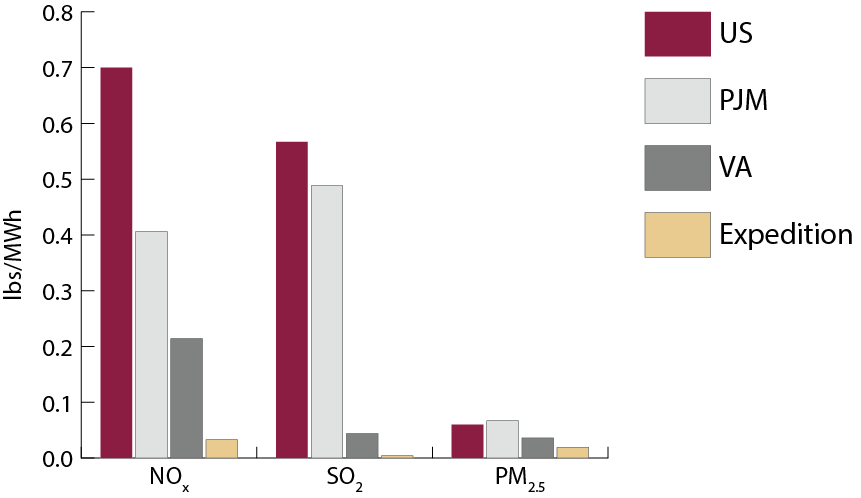
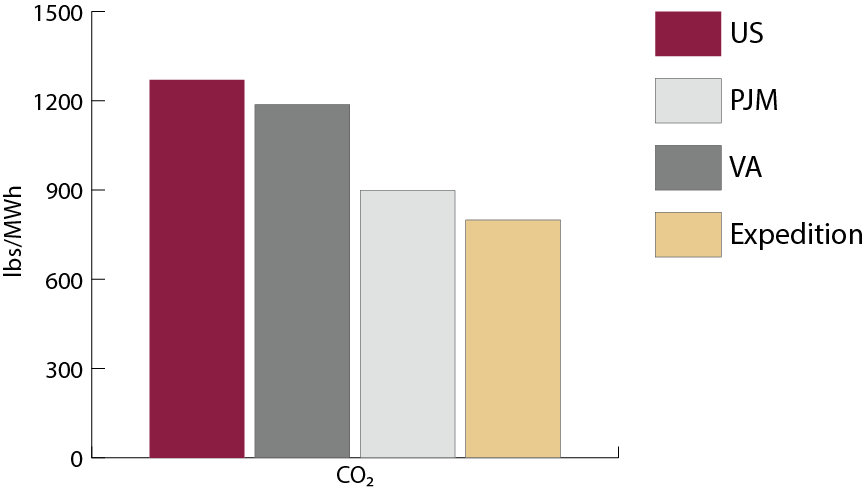
Expedition Anticipated Actual Emission Rates vs. U.S., PJM Interconnection, and VA Fossil Plant Averages
Effective Emissions Controls

The emissions most commonly associated with natural gas-fueled power plants are nitrogen oxides (NOx) and carbon monoxide (CO).
However, with the state-of-the-art design and the use of best available control technology (BACT), emissions will be limited. BACT will include oxidation catalyst and selective catalytic reduction (SCR), in addition to ultra-low NOx burners and water injection, for emissions control.
Ultra-low sulfur diesel (ULSD) will be used minimally as a backup if natural gas supply is challenged.
Responsible Emissions
The Virginia Department of Environmental Quality has stringent requirements related to air quality and natural gas power plants that are intended to protect human health and the environment.
Expedition will be required to demonstrate:
- That it is employing best available control technology (BACT) to minimize emissions.
- That emissions from the plant will not cause off-property concentrations to exceed each of the National Ambient Air Quality Standards (NAAQS) below, when including other specific surrounding sources and existing background concentrations.
| Pollutant | Standard | Averaging Time | Level |
|---|---|---|---|
| Carbon Monoxide (CO) | Primary | 8-hour | 9 ppm |
| Primary | 1-hour | 35 ppm | |
| Nitrogen Dioxide (NO2) | Primary | 1-hour | 100 ppb |
| Primary & Secondary | Annual | 53 ppb | |
| Ozone (O3) | Primary & Secondary | 8-hour | 0.070 ppm |
| Particulate Matter | Primary & Secondary (PM10) | 24-hour | 150 μg/m³ |
| Primary (PM2.5) | Annual | 9.0 μg/m³ | |
| Secondary (PM2.5) | Annual | 15 μg/m³ | |
| Primary & Secondary (PM2.5) | 24-hour | 35 μg/m³ | |
| Sulfur Dioxide (SO2) | Primary | 1-hour | 75 ppb |
| Secondary | Annual | 10 ppb |
All areas of Virginia, except for counties in the DC Metro area and a portion of Giles County, already comply with all of the NAAQS. Expedition will not change that.
